
Salt Lake County Most Wanted Route
Here is the awkward part. Salt Lake County publishes no Sheriff most-wanted page. No photo lineup, no listed count, no refresh schedule, no county reward program. That gap should not be papered over with a made-up roster. Relabeling another agency's page as Sheriff material would mislead you just as much.
So where do you start? The County itself sends you to the Utah Statewide Warrant Search. Both the Sheriff's Find a Prisoner page and its Law Enforcement Bureau page route visitors there. BCI, which runs the service, describes it as a free search of the Utah Statewide Warrants file covering people wanted anywhere in the state. Treat any result as a lead worth confirming. Nothing more.
Salt Lake City Police keeps its own Most Wanted page. Keep in mind that this is City material, not a countywide Sheriff list. Its safety guidance helps. Still, the page cannot tell you whether anyone is currently wanted countywide. The Utah Statewide Warrant Search remains the official online starting point, and the search screen shown below simply marks that path.
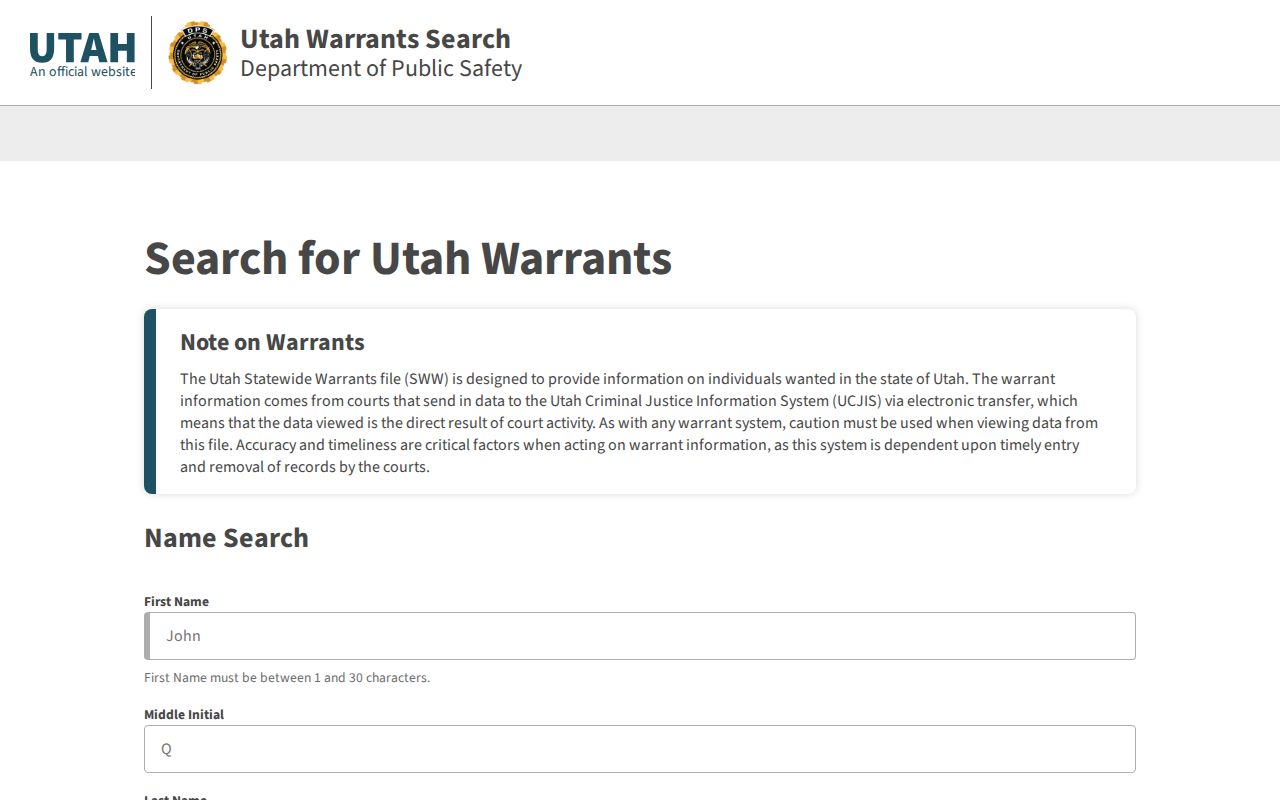
Run the official search first, then confirm whatever comes back with the responsible court or agency.
Salt Lake County Wanted Listing Details
What does a wanted-list entry actually contain? With no current Sheriff list available, Salt Lake County cannot promise the usual fields. The SLCPD page offers a hint. When posts exist, a name under a photo can link to a case or wanted poster. The page also says warrants were issued for the people shown. None of that makes an old post a live warrant.
| Information | How to treat it |
|---|---|
| Person name or image | A possible identification lead that must be confirmed by the agency. |
| Warrant statement | A status claim, not a conviction or final case result. |
| Linked wanted poster or case | Agency context when a current post is available. |
| No current posts | Not proof that no warrant exists anywhere in Utah. |
| County Sheriff list | No verified current public list was found in this research. |
The soundest sequence is simple. Search statewide first. Then go to the court clerk or agency handling the case. When a case has been filed, its file carries the later procedural detail that no wanted notice can give you.
Salt Lake County Warrant Check
Start online. Finish in person or by phone. Confirm any name or record with an official office before acting on it. The Sheriff's Law Enforcement Bureau handles warrants through its Warrants & Extraditions unit, reachable at 385-468-9740 at the Sheriff's administrative address. The BCI search covers the whole state. That makes it the right online first step even for people with Salt Lake County ties.
- Search the official BCI statewide database using the information the form requests.
- Read a result as a verification lead, not a final statement of legal status.
- For a related case, contact the court clerk or consult the public court record.
- For a person directly affected, use an attorney, the court, or the responsible agency to resolve the matter safely.
- Independently verify any unexpected call or message before giving information or money.
One warning from the Sheriff is worth repeating. The office does not call anyone demanding payment for fines or warrants. Hang up on such a call. Dial a known court or agency number yourself. That habit keeps a scam demand from masquerading as a real way to resolve a warrant.
Salt Lake County Warrant Types
Warrant terms vary from record to record. There is no local field guide for the statewide search. The table below offers plain-language distinctions, not predictions about what any result will show. A court or agency still has to confirm what a label means and whether the matter is current, since both depend on the underlying case.
| Term | General record function |
|---|---|
| Arrest warrant | A court-authorized warrant connected to an alleged offense. |
| Bench warrant | A warrant issued by a court in connection with a pending court matter. |
| Extradition matter | A cross-jurisdictional matter handled through the responsible agencies. |
| Wanted notice | A public agency notice, which may cover only some warrant information. |
A label alone answers little. It cannot tell you whether a matter is active, recalled, served, or tied to another jurisdiction entirely. So skip the shortcuts too. An old social post, an unofficial index, or a matching name settles nothing.
Salt Lake County Wanted Safety
Never try to apprehend, follow, contact, or confront someone over a wanted entry. SLCPD says as much on its wanted page. The listings alone do not justify an arrest, it notes, and verification questions and tips go to its non-emergency line. Keep one more caution in mind. Public notices can be outdated, incomplete, or attached to the wrong person when names run similar.
Safety notice: For an immediate danger, call emergency services, and route non-emergency tips or verification through a known official number so trained personnel can respond.
A warrant opens a court process. It settles nothing on its own. Anyone facing one is better served by working with a lawyer, a court, or the responsible agency than by trying to outrun the issue. Facing it directly is the safer course.
Salt Lake County Tip Contacts
No verified County Crime Stoppers reward, anonymity guarantee, or tip infrastructure turned up in the source material for a Sheriff wanted list. Assume neither payment nor confidentiality. The closest official local policy sits with City police. The SLCPD route below serves only its stated purpose.
Salt Lake City Police Department non-emergency
For wanted-list verification or tips stated on its City page
801-799-3000
For county warrant functions, call the Sheriff's Law Enforcement Bureau at 385-468-9740. Run the BCI search first. That way you can describe your question accurately. If the issue involves a filed case, the clerk and the court record are the right places to confirm it.
Salt Lake County Wanted and Custody
A warrant hit and a jail booking answer two different questions. Someone can have an active warrant and never spend a night in County custody. Someone else can be booked in without appearing on any wanted page. For custody questions, the Salt Lake County booking-record and custody route is the better starting point. It explains the inmate lookup and the dated Jail In/Out Docket. Custody status shifts fast. A person can be released or transferred the same day, so a stale page misleads.
Each system answers one thing well. The County lookup shows who is in jail right now, searchable by name or booking identifier. The daily docket tracks movement on one calendar date. Court files pick up a case only after charges are filed. State supervision falls to Utah Department of Corrections, not the County jail. Mixing these tools together creates errors. Treating a wanted-list entry as a roster result is one of the most common mistakes.
Salt Lake County Court Confirmation
Utah Courts Xchange is the public window into district and justice court cases, within its own access limits. Parties, filings, hearings, judgments, and closed-case outcomes all appear there. For Third District case status, the District Attorney's information points callers to the court directly at 801-238-7300. An empty result is not the end of the story. The file could be sealed, expunged, juvenile, unfiled, or sitting in a different court entirely.
Court records have a timeline of their own. Arraignment comes first. Charges and plea options are addressed at that stage. Disposition comes later, whether that means dismissal, acquittal, a plea outcome, or a sentence. Follow that sequence when checking a booking or warrant question with the court that actually holds the file.
Salt Lake County Wanted List Limits
Salt Lake County has no verified public wanted-list count. There is no confirmed posting schedule, photograph policy, reward amount, or anonymous-tip promise either. That gap does not make the statewide warrant file incomplete. By the same token, a statewide warrant hit does not mean the person belongs on a local public page. Coverage and warrant status are separate questions, and confusing them leads people astray.
The accurate local route runs through a BCI search, then confirmation with the agency or the court. SLCPD sometimes posts city police notices. Its historical archive is not a live list. When the custody question stands apart from the warrant question, the inmate lookup and dated County documents are the right tools.
Warrant data has a shelf life. No static page can fix that. Courts change case statuses, agencies update records, and multiple jurisdictions can hold pieces of the picture. That is why the BCI search works best paired with a court clerk, the responsible agency, or a lawyer. Never treat an online listing as an instruction to act. Do not identify a person from a partial name, an old photo, or an unverified social media post.
One safeguard comes straight from County public safety materials. The Sheriff will not call anyone and demand payment for a warrant or fine. Anyone who gets such a call should hang up and dial a known official number, never the one the caller supplies. A real warrant question gets resolved through a court or agency. Pressure calls tend to be fraud. Nothing here advises on avoiding a warrant; it points to safe confirmation and formal resolution.
Once a person enters County custody, the records change scope. The live lookup covers current jail custody. A daily docket documents movement near a particular date. A filed court case then carries the hearings and eventual disposition. State supervision and federal custody each require their own tools. Keeping these records separate prevents a common error: assuming that no wanted-page post means no official record exists.